
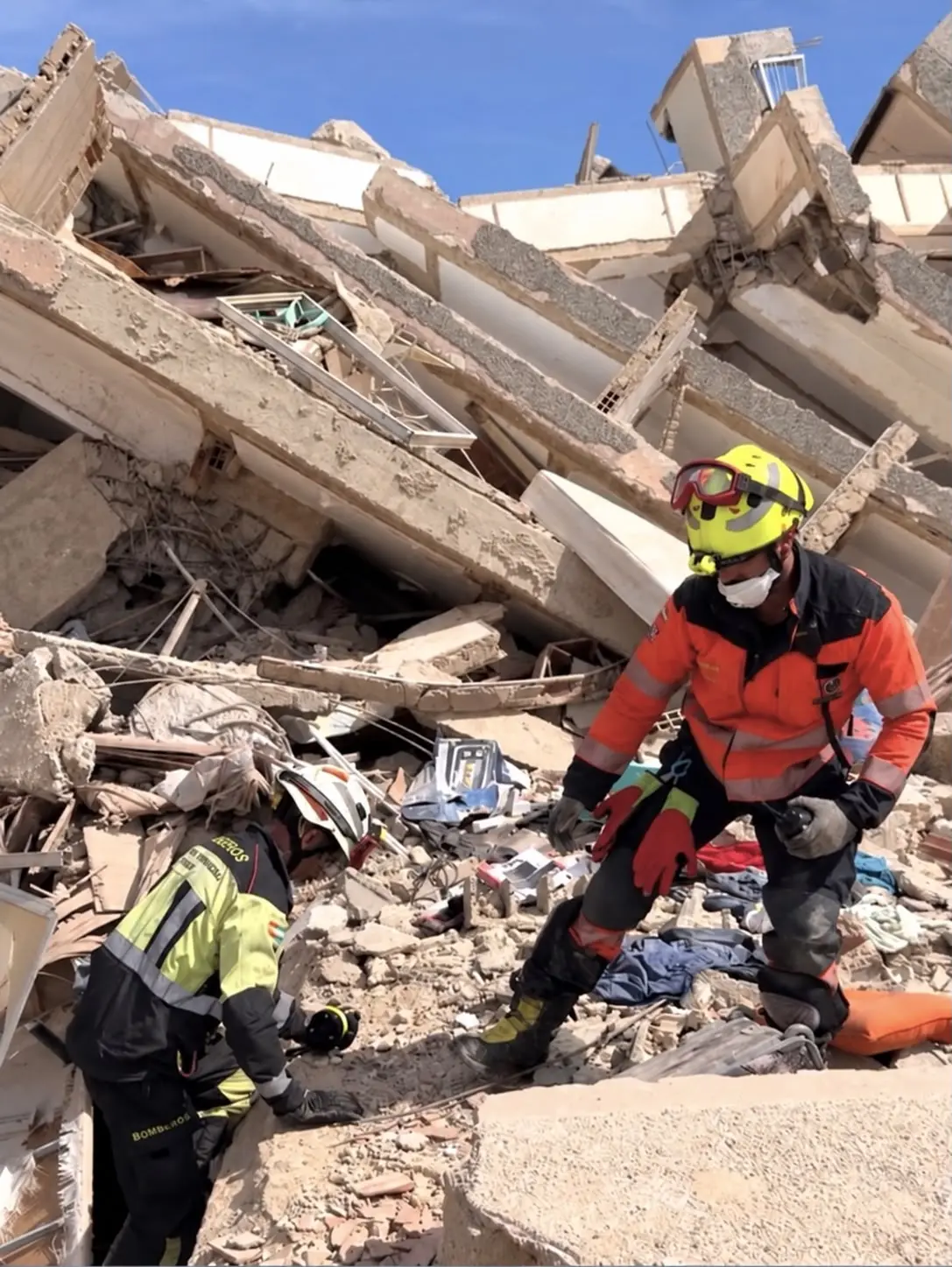
Finally, we interviewed Jose Castillo, a new firefighter who joined just over a year ago and also participated in the Venezuela earthquakes with the NGO.
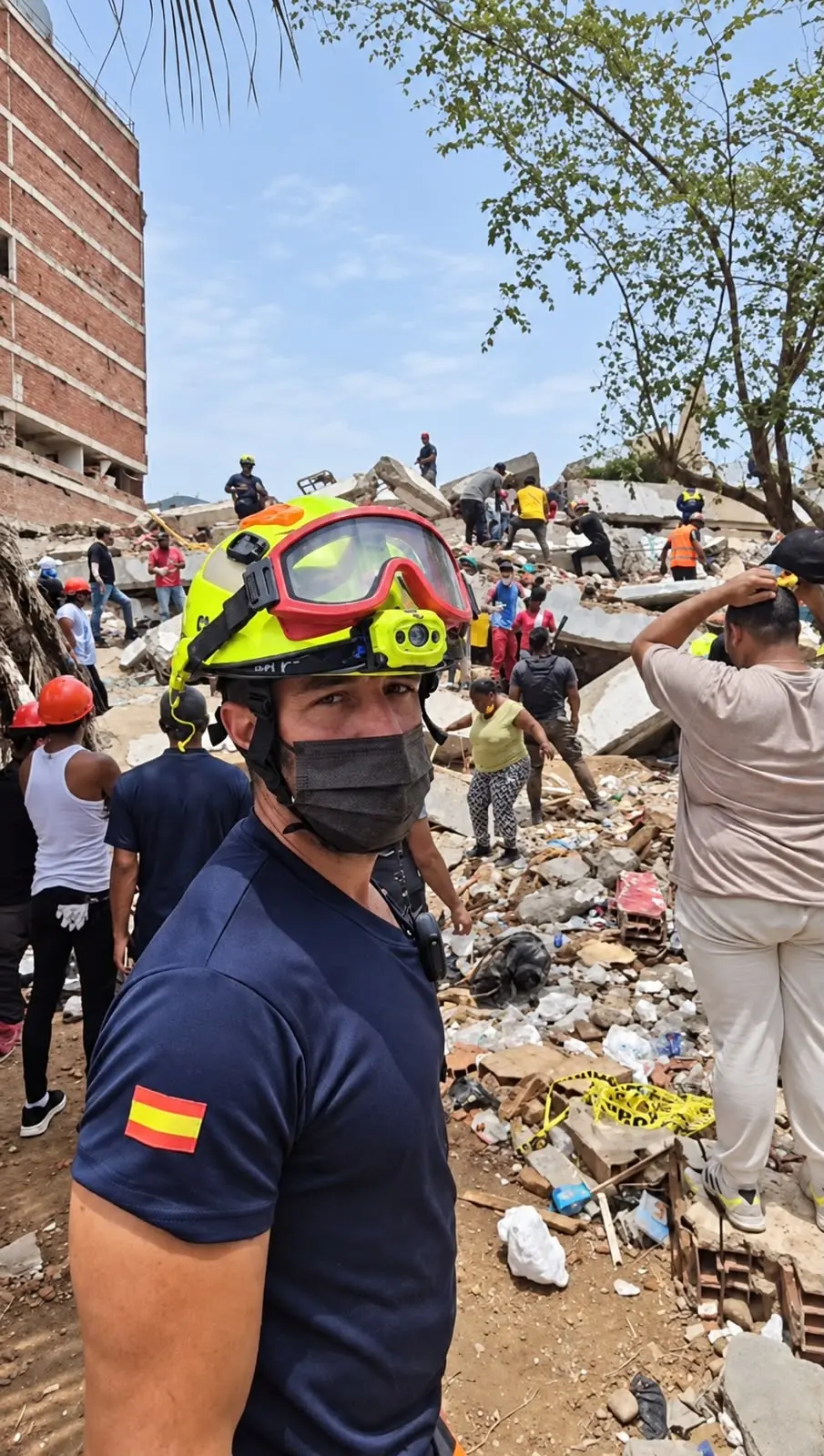 “The real difference is made by judgment, discipline, and the ability to keep a cool head.” Jose Castillo
Was there a moment during the mission when you thought: “This is completely different from anything I had imagined”?
Yes. I think before leaving, you try to imagine what something like this will be like, but it’s impossible. I left with many uncertainties: I didn’t know exactly what we would find, how I would physically respond after many hours without sleep, or even if I would truly be up to the task when the time came.
And then, once there, what surprised me most was how quickly something extraordinary can become your normal. You’re tired, you sleep very little, you eat when you can, you haven’t showered in days, and yet, you keep functioning because there’s a job to do and a team that also depends on you.
Perhaps that was the most different from what I imagined. From the outside, you think a lot about adrenaline or big moments; from the inside, a large part of such a mission consists of keeping a cool head, constantly adapting, and continuing to do your job well even if the conditions are far from ideal.
What was the most difficult thing to face during these days on the ground?
Probably the accumulated fatigue. In five days, I slept around fourteen hours in total. At first, you can run on adrenaline, but there comes a point where that feeling of being especially activated no longer exists: you’re simply tired and you have to continue being useful.
And for me, that was important. I wasn’t just worried about physically enduring; I was worried about not becoming a burden to others. You’re working with colleagues, some with much more experience than you, and you want to respond when needed.
There’s also the uncertainty. You’re away from home, in another country, in an exceptional situation, and with practically no control over what might happen the next day. You learn quite quickly to stop thinking too far ahead and concentrate on what’s in front of you.
What have you learned from your more experienced colleagues that you will carry with you for the rest of your career as a rescuer?
Above all, that experience is much less noticeable in doing spectacular things than in consistently doing the small things well.
The calm with which they analyze a situation, how they communicate, how they manage effort, how they know when to act and when to wait… Those kinds of things impressed me a lot.
I think when you start this job, you might have the idea that being a good rescuer has a lot to do with being strong, brave, or decisive, and of course, all that matters. But there, I understood even better that the real difference is made by judgment, discipline, and the ability to keep a cool head.
And another fundamental thing: trusting the team. In a mission like this, you perfectly understand that no one does anything alone. Knowing that you have competent people by your side allows you to concentrate on doing your part well. It’s a lesson I want to keep throughout my career.
When you returned home, what was the first thing you did or thought? Has this experience changed your way of seeing life?
The first thing I did is quite easy to guess: shower. Shower and hug my family. Then I had my favorite meal and slept as much as I could.
The experience has undoubtedly been one of the best of my life, always understanding and respecting the gravity of the situation that led us there. But precisely because of that, it has also been a very transformative experience.
One of the first things I learned was how far the body can go when it truly has a reason to keep going. During those days, there was fatigue, lack of sleep, and moments of great wear, and yet I discovered that I was capable of enduring much more than I thought.
But probably what impacted me most happened upon my return. Suddenly I was back home, hugging my family, able to shower, eat whatever I wanted, and sleep in my bed, while thousands of kilometers away, many people were still living the consequences of one of the greatest tragedies of recent years. That contrast was very difficult to assimilate.
I even felt some guilt for leaving and returning to my life, even though I rationally knew that our search work, 7 days after the earthquake occurred, unfortunately, was no longer so necessary. It was a strange feeling: on the one hand, leaving all that behind; and, on the other, feeling profoundly grateful to be able to return to a life where everything was still well.
I think that’s one of the things that has stayed with me most. Many times we take what we have for granted because we think, almost without realizing it, that it will always be there: our family, our home, our routine, even the smallest things. When you see up close how quickly everything can change, you start to understand that perhaps we shouldn’t take so many things for granted.
Since then, I try to value everything around me much more. And I also think I’ve come back a more resilient person. Although it was a relatively brief experience, it showed me that I am capable of enduring much more than I thought and has changed my perspective on many everyday problems. Things that once seemed enormous, after living something like this, begin to occupy their rightful place.
It doesn’t mean they stop mattering, but you learn to put them into perspective. And, above all, to appreciate what you have much more while you have it.