Introduction
In disaster situations such as earthquakes, explosions, or structural collapses, specialized urban search and rescue teams play a fundamental role in saving lives.
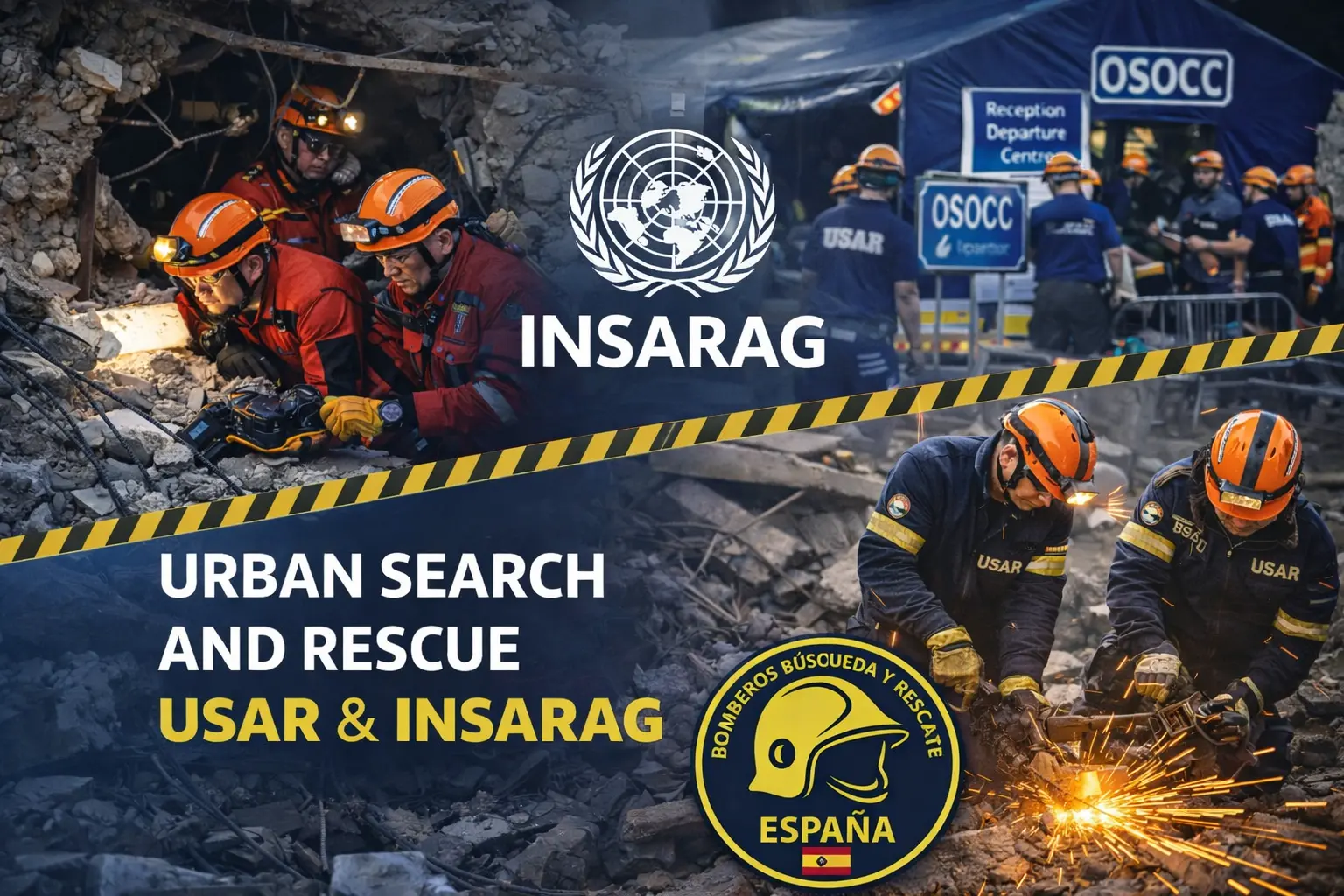
These teams operate under the concept of USAR (Urban Search and Rescue), a set of capabilities designed to locate, access, and rescue individuals trapped under debris, following international standards established by INSARAG (International Search and Rescue Advisory Group), which is part of the United Nations.
In this article, we explain what a USAR team is, how it is organized, and what INSARAG terminology is used in these types of interventions.
What is a USAR Team?
A USAR team is a specialized unit that integrates different capabilities to intervene in collapsed structures, with the objective of locating, rescuing, and stabilizing trapped individuals.
The USAR concept does not refer solely to a team, but to the entire set of human, technical, and organizational resources necessary to carry out these types of operations.
These teams are prepared to act both nationally and internationally, especially in large-scale situations.
Main Functions of a USAR Team
USAR teams perform several key functions during a rescue operation:
Search and Victim Location
Use of acoustic devices and search cameras
Support from specialized canine units
Tracking techniques in collapsed structures
Access and Technical Rescue
Breaching structures
Use of hydraulic and cutting tools
Stabilization of structural elements
Initial Medical Care
Assessment of victims' condition
First aid and stabilization
Preparation for evacuation
Structural Assessment
Identification of risks
Stability analysis
Prevention of further collapses
Organization of a USAR Team
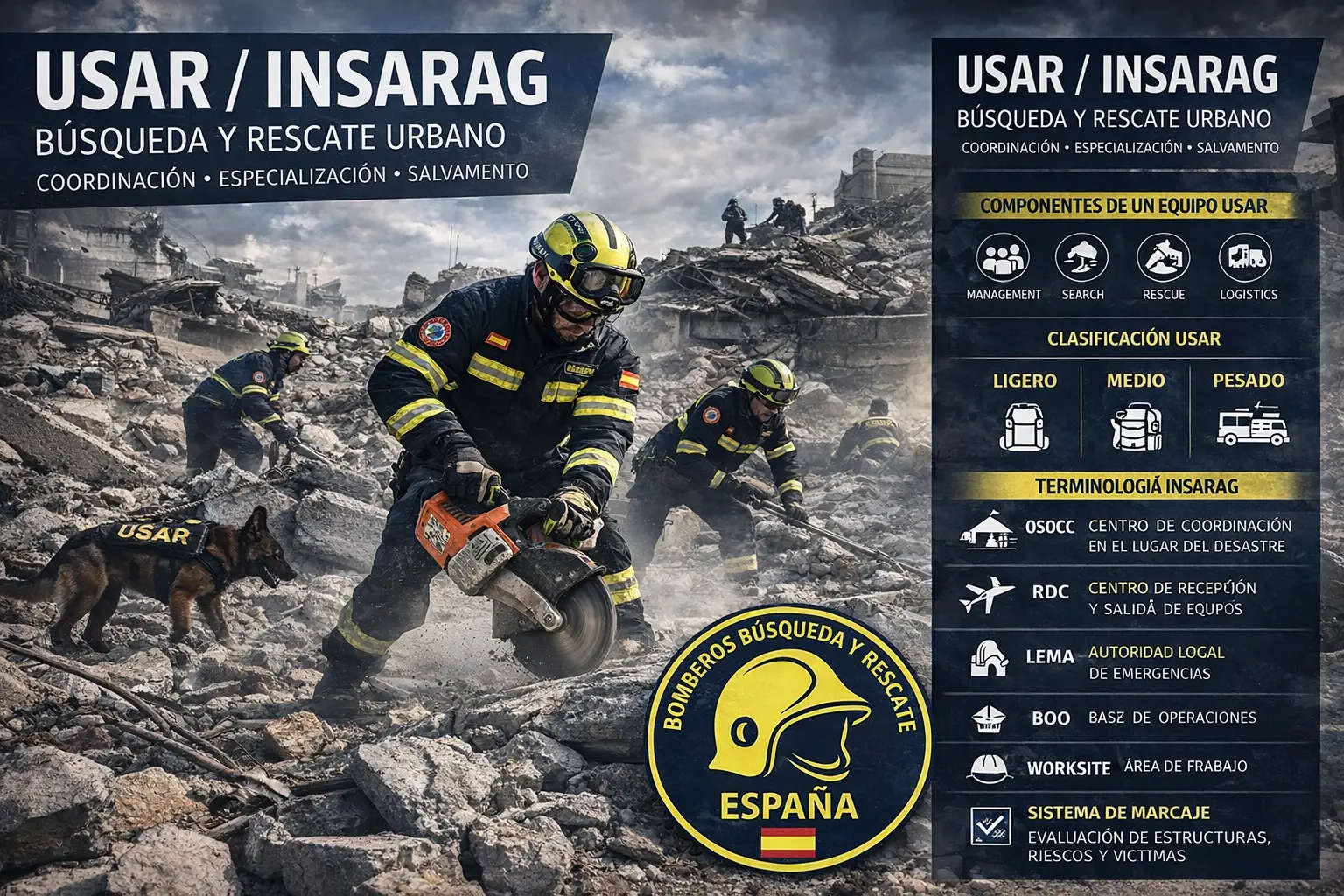
According to international INSARAG standards, a USAR team is organized into five main components:
Management
Responsible for coordination, decision-making, and liaison with authorities.
Search
In charge of locating victims using technical and canine means.
Rescue
Specialists in accessing, stabilizing, and extracting victims.
Medical
Provides initial medical care to both victims and the team itself.
Logistics
Manages resources, transportation, communications, and team self-sufficiency.
Classification of USAR Teams
INSARAG establishes a classification based on the operational capacity of the teams:
Light USAR
Basic interventions
Limited capacity
Generally not deployable internationally
Medium USAR
Advanced technical capability
Operations in collapsed structures
Continuous work for several days
Heavy USAR
High operational capacity
Complex interventions
Self-sufficient and internationally deployable teams
What is INSARAG and its Role in Emergencies
INSARAG (International Search and Rescue Advisory Group) is an international network supported by the United Nations that establishes standards and procedures for the coordination of USAR teams in emergencies.
It is not a mandatory regulation, but rather an international framework of reference that improves coordination and effectiveness in rescue operations, especially in international interventions.
Key INSARAG Terminology in Search and Rescue
Understanding INSARAG terminology is fundamental to understanding how operations are organized:
OSOCC (On-Site Operations Coordination Centre)
Coordination center at the disaster site that facilitates the organization of international teams and supports local authorities.
RDC (Reception/Departure Centre)
Reception and departure point for international teams, where resources arriving in the affected country are registered and organized.
LEMA (Local Emergency Management Authority)
Local authority responsible for emergency management and decision-making.
Base of Operations (BoO)
Area where the USAR team establishes its logistical and operational base.
Worksite
Specific area where search and rescue work is carried out.
INSARAG Marking System
Standardized system used to identify:
evaluated structures
identified risks
presence of victims
Importance of USAR Teams in Emergencies
USAR teams are essential in situations where time is a critical factor.
Their intervention allows for:
increasing survival probabilities
reducing risks in complex rescues
improving international coordination
acting in an organized and efficient manner
Especially in disasters such as earthquakes or structural collapses, their role is key to saving lives.
Conclusion
A USAR team represents the highest level of specialization in search and rescue in collapsed urban environments.
Thanks to international INSARAG standards, these teams can work in a coordinated, safe, and effective manner anywhere in the world.
The combination of training, organization, and technology makes USAR teams a fundamental element in emergency response.