
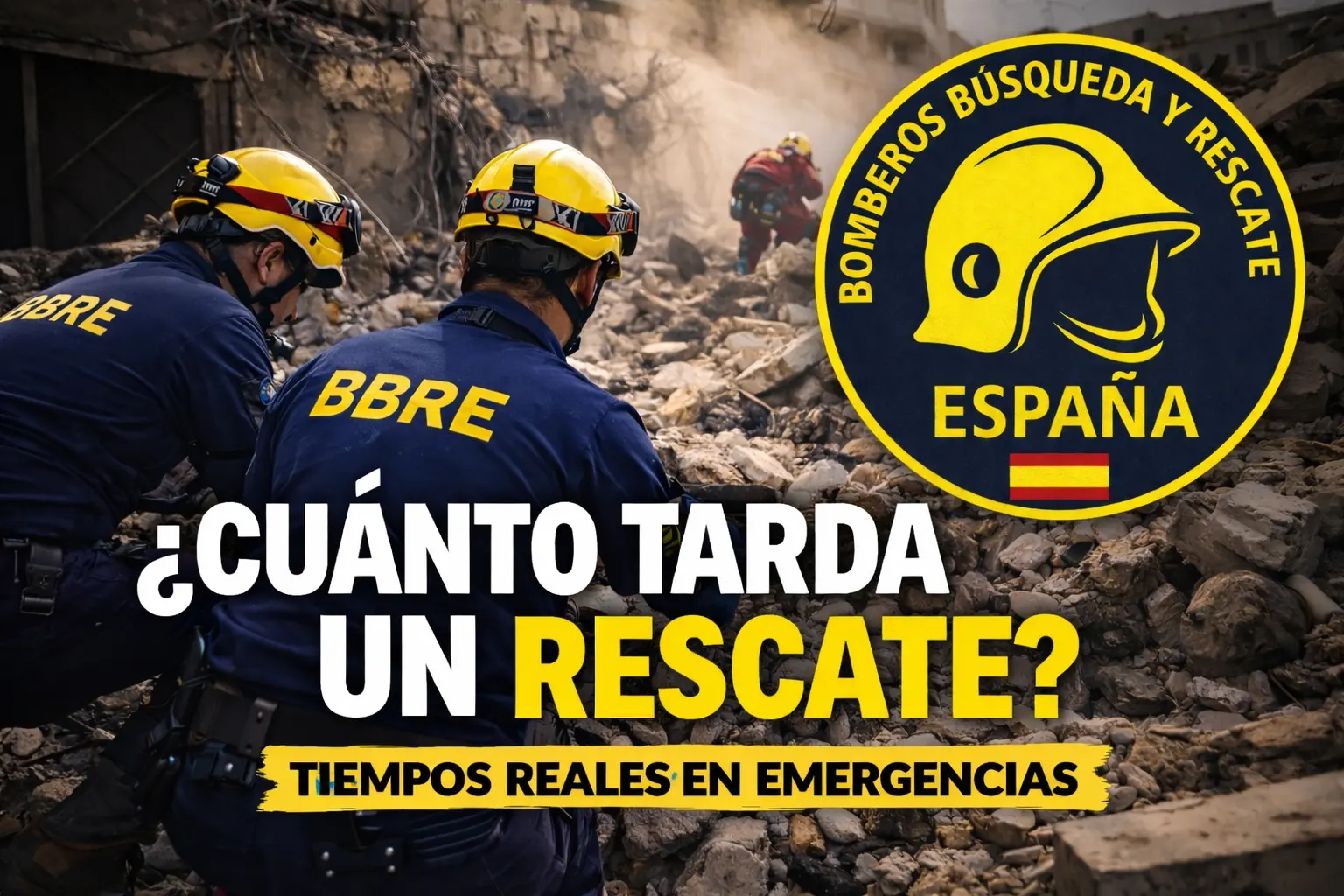
Introduction
When an emergency occurs, many people ask the same question:
Why does it take so long for rescue teams to arrive?
The reality is that a rescue isn't just about arriving and acting. Behind it lies a complex process where every decision can make the difference between life and death.
In this article, we explain how long a rescue actually takes, what factors influence it, and why speed doesn't always mean haste.
How Long Does a Rescue Take in an Emergency?
There is no single answer.
A rescue can take:
minutes (in simple interventions)
hours (in complex situations)
days (in major catastrophes like earthquakes or collapses)
Every emergency is different, and the time depends on multiple variables.
Phases of a Real Rescue
To understand the timelines, it's important to know the phases any intervention follows:
1. Activation and Mobilization
It all begins with the alert to emergency services.
In this phase:
the alert is received
the information is evaluated
the teams are mobilized
This can take from minutes to longer if information is limited.
2. Arrival at the Scene
Once activated, the teams travel to the location.
Factors that influence this:
distance
complicated access
traffic or weather conditions
3. Situation Assessment
Before acting, the environment is analyzed.
This involves studying:
structural stability
risks to rescuers
number of potential victims
This phase is crucial and cannot be skipped.
4. Search and Location
Here, the most delicate work begins:
visual search
use of technology (drones, cameras, detectors)
support from rescue dogs
This can take from minutes to days.
5. Access and Rescue
Once the victim is located:
access is opened
the area is stabilized
the extraction is performed
In collapsed structures, this process can be extremely slow.
Factors Influencing Rescue Time
The time of a rescue doesn't solely depend on the team's speed.
Type of Emergency
Traffic accident → faster
Collapse or earthquake → much more complex
Accessibility
Urban areas → better access
Mountains or isolated areas → greater difficulty
Structural Condition
Unstable buildings require slow and safe work
Environmental Conditions
rain, cold, extreme heat
lack of light
Number of Victims
the greater the number, the greater the complexity
Why Isn't a Rescue Always Immediate?
Because acting quickly without safety can worsen the situation.
A mistake can:
cause new collapses
endanger the team
reduce survival chances
In rescue operations, going slower often means saving more lives.
The Myth of Speed
There's a notion that a rescue must be immediate.
But the reality is different:
every movement is calculated
every action is secured
every decision is made with precision
It's not about going fast, but about doing it right.
Real Cases: Rescues That Last Days
In major catastrophes, such as earthquakes, rescues have occurred:
after 24 hours
after 48 hours
even after 72 hours
These cases demonstrate that perseverance and technique are key.
Conclusion
A rescue isn't a matter of minutes, but of precision, coordination, and safety.
The next time you wonder why emergency teams are taking so long, remember this:
Behind every intervention is a process designed to maximize the chances of saving lives.
Because in rescue, every second counts… but so does every decision.