
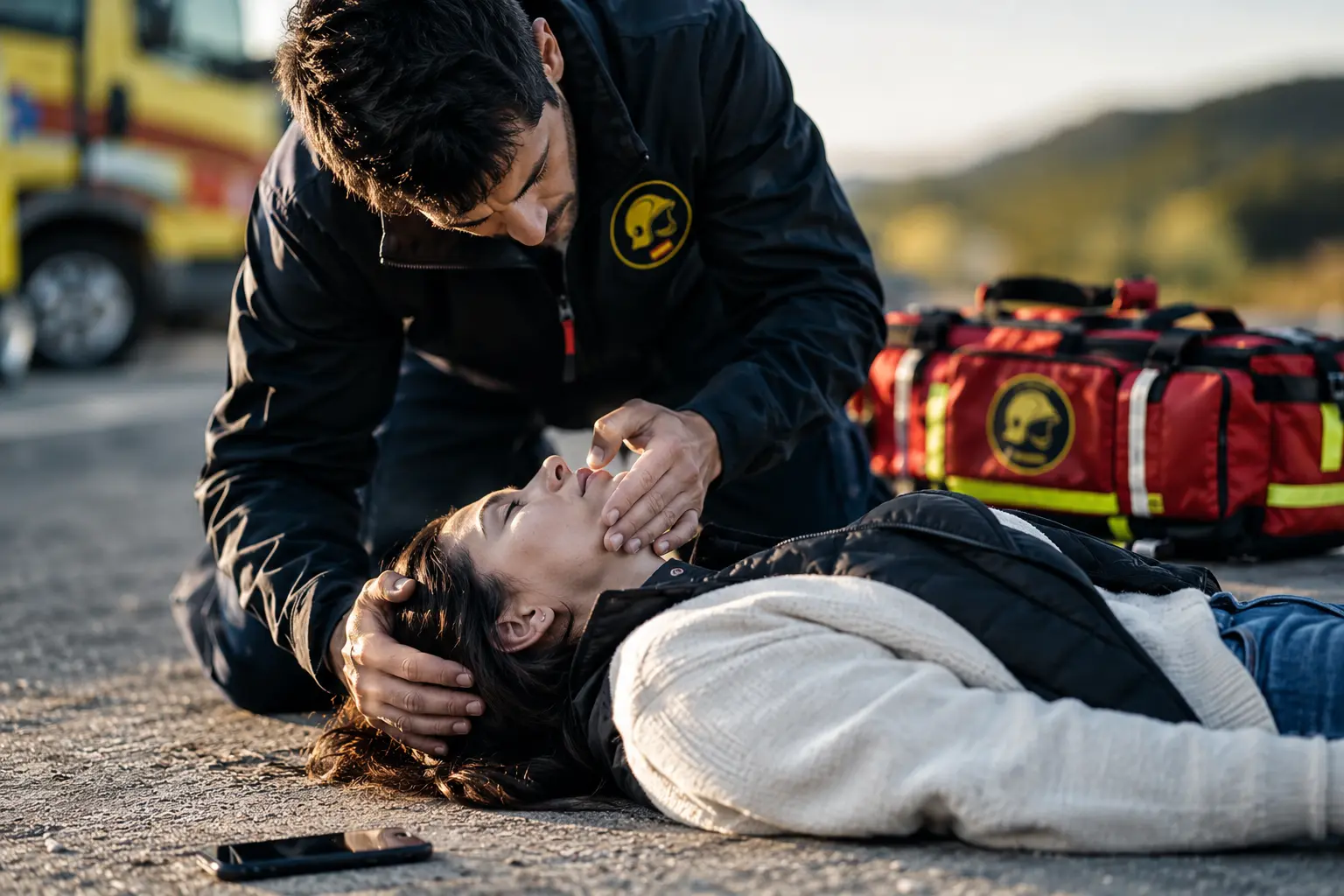
What to do if you find an unconscious person? Step-by-step first aid guide
Finding an unconscious person can be a distressing situation. Not knowing what happened, if they are breathing, or how to help them can create doubts in crucial seconds.
However, you don't need to be a healthcare professional to provide initial help. Knowing how to recognize an emergency, call 112, and act correctly while professionals arrive can help save a life.
From Bomberos Búsqueda y Rescate España (BBRE), we explain what to do if you find an unconscious person, how to check if they are breathing, when to start cardiopulmonary resuscitation (CPR), and what mistakes you should avoid.
New series from BBRE: WHAT TO DO IF...?
From Bomberos Búsqueda y Rescate España (BBRE), we are launching a new series of articles under the title “WHAT TO DO IF…?”, with which we want to bring practical knowledge about emergencies, first aid, prevention, and action in situations that can occur in our daily lives to the public.
Sometimes, having a few concepts clear and knowing the correct order of action can make a big difference. Therefore, we want to offer useful, understandable, and verified information that helps to recognize an emergency, make better decisions, and know how to act until the arrival of emergency services.
Through this series, we will address different situations, explaining step-by-step what to do, what mistakes to avoid, and what basic recommendations everyone should know.
Because knowing how to act doesn't always require being a professional, but knowing the right steps can be decisive.
We inaugurate this series with an especially important situation: what to do if you find an unconscious person?
1. Check that the place is safe
Before approaching, observe the surroundings and check that there is no danger to you or the affected person.
Pay attention to possible risks such as traffic, fire, smoke, electrical wires, collapses, or the presence of dangerous substances.
If the place is not safe, do not expose yourself. Notify emergency services and follow their instructions.
This first action is part of the PAS behavior: Protect, Alert, and Support, a fundamental first aid sequence.
2. Check if the person responds
If you can approach safely, check if the person is conscious.
Speak to them loudly and ask if they can hear you.
If they do not respond, you can gently stimulate them by tapping their shoulders.
Do not shake them vigorously, especially if they may have suffered a fall or trauma.
If the person does not respond, consider it an emergency and call 112 as soon as possible. If someone is with you, ask them to make the call while you continue to assess the victim.
If you are alone, use the phone's speaker to follow the operator's instructions while attending to the person.
3. Check if they are breathing normally
While help is being activated, you must check if the unconscious person is breathing normally.
If you know how, open the airway using the head-tilt/chin-lift maneuver, gently tilting the head back and lifting the chin. If you suspect a cervical injury or significant trauma, avoid unnecessary movements and follow the instructions of the 112 operator.
Observe the movement of the chest and pay attention to breathing for a maximum of 10 seconds.
It is important to distinguish between normal breathing and abnormal breathing.
Do not confuse isolated gasps with normal breathing. A person who exhibits gasping, irregular gasps, or agonal breathing may be suffering a cardiorespiratory arrest.
From here, the action depends on what you observe.
4. What to do if the person is unconscious but breathing normally?
If the person does not respond but is breathing normally, they need urgent medical attention.
Act as follows:
Make sure 112 has been notified.
Maintain a clear airway and continuously monitor their breathing.
If there is no suspicion of significant trauma or other contraindication, place them in the recovery position to help keep the airway open.
Do not give them water, food, or medication.
Do not leave them alone and check if their condition changes.
If the person has suffered a fall, a traffic accident, or a significant blow, avoid moving them unnecessarily due to the possible risk of spinal injury. The priority is to maintain the airway and follow the professionals' instructions.
If they stop breathing normally, you should begin the appropriate action for a possible cardiorespiratory arrest.
5. What to do if the unconscious person is not breathing or only gasping?
This is one of the most urgent situations. A person who does not respond and is not breathing normally may be suffering a cardiorespiratory arrest.
In that case, do not waste time trying to find out what happened.
Step 1. Call 112 and ask for a defibrillator
If you haven't called yet, do so immediately. Put the phone on speaker and follow the operator's instructions.
If there are other people present, ask someone to find an automated external defibrillator (AED) while you begin resuscitation.
Step 2. Start chest compressions
Place the person on their back on a firm surface, always provided you can do so safely.
For an adult:
Place the heel of one hand in the center of the chest and the other hand on top.
Keep your arms extended and your shoulders positioned over your hands.
Compress the chest between 5 and 6 centimeters.
Maintain a rate of 100 to 120 compressions per minute.
Allow the chest to return to its position after each compression.
If you are trained and can perform ventilations, alternate 30 compressions with 2 ventilations. If you don't know how to perform them, follow the phone instructions from 112 and start chest compressions.
Step 3. Use the defibrillator if available
Turn on the AED and follow the device's voice instructions.
Place the pads on the bare chest following the device's diagrams and ensure no one touches the victim when the defibrillator analyzes the rhythm or indicates to deliver a shock.
Afterward, continue with CPR maneuvers when the device indicates.
Step 4. Continue until help arrives
Maintain resuscitation maneuvers until the person shows clear signs of recovery and breathes normally, professionals take over, or you are physically unable to continue.
If you have doubts, the 112 operator can guide you during the intervention.
6. What mistakes should you avoid when finding an unconscious person?
In an emergency, some instinctive reactions can delay help or worsen the situation.
Do not do the following:
Do not throw water in their face or hit them to try to wake them up.
Do not give them food, drink, or medication.
Do not leave them alone if you can safely stay with them.
Do not blindly put your fingers in their mouth to search for objects.
Do not unnecessarily move a person who may have traumatic injuries.
Do not delay calling 112 by trying to figure out the cause of unconsciousness on your own.
Do not confuse isolated gasps with normal breathing.
If they do not respond and you are unsure if they are breathing normally, call 112 and explain what you observe. Follow the operator's instructions.
7. What to do if the person regains consciousness?
If the person becomes responsive again, do not assume the danger has passed.
Check if they are oriented, if they are breathing normally, and if they present symptoms such as chest pain, difficulty breathing, sudden weakness, seizures, or signs of having suffered trauma.
If the loss of consciousness was unexplained, they suffered an injury, or they do not fully recover, they need medical evaluation. Call 112 at any sign of seriousness.
Do not allow them to stand up abruptly or give them food, drink, or medication until they are fully recovered and the situation has been assessed.
The importance of knowing how to act in an emergency
An unconscious person needs a quick and orderly response. Checking the safety of the surroundings, activating emergency services, assessing breathing, and knowing when to start CPR are actions that any citizen can learn through first aid training.
From Bomberos Búsqueda y Rescate España (BBRE), we advocate for the importance of preparation, prevention, and training to improve emergency response.
We cannot always prevent an accident from happening, but we can prepare to react better when it does.
Remember the fundamental steps: protect the area, call 112, check if the person responds and breathes normally, and act according to the professionals' instructions.
An act