
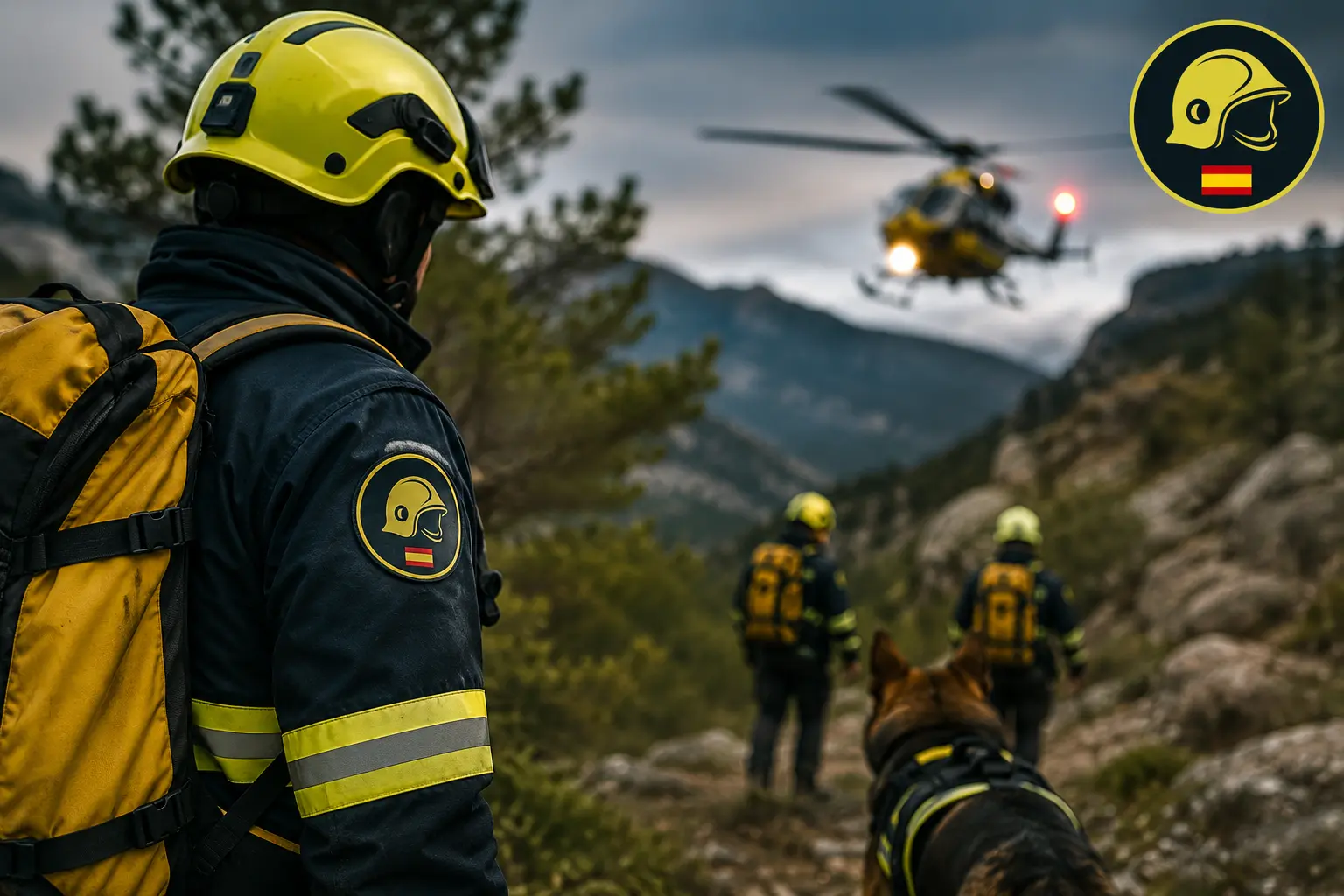
How do firefighters find a missing person?
This is how a real search and rescue operation works
When we hear on the news that a person has gone missing in the mountains or that a rescue team has been searching for hours, it is common to wonder how it is possible to find someone in such a vast area.
Forests, mountains, ravines, trails, weather changes, or the arrival of night turn every search into a real challenge.
However, behind every rescue, there is planning, methodology, and coordinated work that greatly increases the chances of success.
As firefighters, we have participated in numerous searches and rescues, and today we want to explain what happens from the moment the alert is received.
What happens when a missing person report is received?
The first thing that is done is to collect all available information.
Although many people think that the most important thing is to head out and search immediately, the reality is that having reliable data can save hours of searching and significantly increase the odds of finding the person.
Essential information to start the search
Teams try to obtain data such as:
Last place they were seen.
Approximate time of disappearance.
Planned route.
Physical condition of the person.
Experience in the mountains or hiking.
Clothing they were wearing.
Mobile phone and battery level.
Possible medical issues.
Each of these details can be decisive.
The importance of the last known location
One of the most important concepts in search and rescue is the so-called "last known point."
Why is it so important?
Because it allows for the establishment of an initial search area.
The more precise the information about the last place the person was, the more effective the deployment of the teams will be.
A photograph sent via WhatsApp, a shared location, or even a social media post can become fundamental clues.
How firefighters organize a search for missing persons
Contrary to what many people imagine, a search does not consist of walking randomly hoping to find someone.
Terrain sectorization
The area is divided into different sectors.
Each team receives a specific zone to review systematically to avoid duplication or unreviewed spaces.
Coordination between teams
In a search, participants usually include:
Firefighters.
Specialized rescue teams.
Law enforcement.
Civil Protection.
Accredited volunteers.
K9 units.
Aerial assets.
Coordination among all of them is fundamental.
The role of search and rescue dogs
Dogs are one of the most effective tools for locating missing persons.
How do rescue dogs work?
Thanks to their extraordinary sense of smell, they can detect human tracks at great distances and in conditions where people would face immense difficulties.
Their ability to cover large areas in a short time makes them essential allies during the first few hours.
What role do drones and helicopters play?
Technology has revolutionized search operations.
Advantages of drones
Drones allow for:
Covering large areas quickly.
Accessing dangerous zones.
Detecting movement.
Locating points of interest.
Rescue helicopters
When conditions allow, helicopters provide a privileged view of the terrain and allow quick access to hard-to-reach places.
The first 24 hours can make the difference
In any search, time is a determining factor.
Why is it so important to act fast?
Because the person can:
Move away from the initial area.
Suffer an injury.
Run out of battery.
Be exposed to cold or heat.
For this reason, it is fundamental to notify emergency services as soon as a real disappearance occurs.
What to do if you get lost in the mountains
Many searches could be resolved sooner if the missing person follows some basic guidelines.
Stay calm
Panic often leads to wrong decisions.
Avoid walking aimlessly
One of the most common mistakes is to keep moving without knowing where you are.
Conserve phone battery
Use the phone only when necessary.
Make yourself visible
If you hear search teams:
Use a flashlight.
Make signals.
Use a whistle if you have one.
Common mistakes that hinder a search
As emergency professionals, there are several mistakes we see repeated frequently:
Going out alone without informing anyone
It is always advisable to communicate the planned route.
Not carrying enough battery
A mobile phone can be the difference between being located quickly or spending hours waiting for help.
Underestimating the environment
Many disappearances begin with phrases like:
"It's an easy route" or "I'll only be out for an hour".
Prevention is still the best tool
Most rescues end well thanks to the coordinated work of emergency teams.
However, many of these situations could be avoided with proper planning.
Before going out to the countryside or the mountains:
Check the weather forecast.
Inform someone of your route.
Bring enough water.
Charge your phone.
Carry an external battery.
Wear appropriate clothing.
Small measures that can prevent an emergency.
Conclusion: Behind every rescue, there is preparation, coordination, and time
When a person goes missing, a complex operation begins involving numerous professionals and resources.
Behind every search, there are hours of planning, coordination, and effort with a single goal: to locate the person as soon as possible and bring them back home.
And although rescue teams are prepared to act, the best help always starts before the emergency: with proper prevention and preparation.